Story Neighborhood
Every person is a neighborhood made of stories.
What is Story Neighborhood?
Story Neighborhood™ is a narrative mapping methodology designed by Lily Be to help people better understand themselves and one another through lived experience, emotional intersections, and storytelling.
Instead of debating opinions or reducing people to labels, participants explore moments from their lives connected to feelings, people, places, and experiences.

Every Neighborhood Needs A Name
Names are determined by the teller or the group.
The name of the neighborhood guides the moments we turn into STORY PLOTS.
Every Narrative Gets an Address
That address is a five word title that tells us a little or a lot about the STORY PLOT.
It makes every STORY PLOT identifiable by the teller and the reader.

Every Address Sits at an Intersection
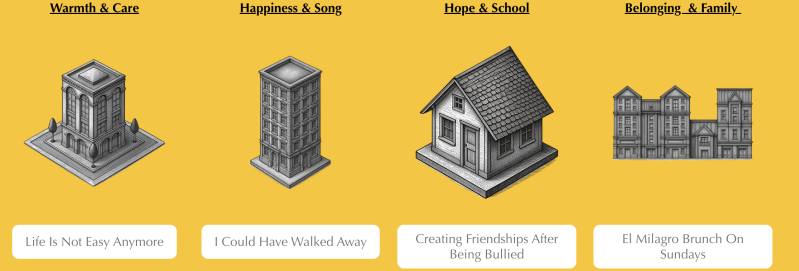
Every Story Plot has a feeling and a noun that is more prominently featured. Every Story Developer gets to decide what noun and feeling stuck out to them in their moment.
THE STORY ADDRESS LIVES ON AN INTERSECTION OF FEELING & NOUN
Every Moment Is Developed Into A Plot With
THE VIBE FIVE
EVERY PLOT IS DEVELOPED BY ANSWERING THE VIBE FIVE.
FIVE QUESTIONS DESIGNED TO CENTER THE TELLER WHILE DEVELOPING THIER STORY PLOT.
EVERY STORY PLOT ADDS TO THE STORY DEVELOPERS NEIGHBORHOOD OF MOMENTS.
EVERY NEIGHBORHOOD OF MOMENTS CREATES A WORLD FOR PEOPLE TO BETTER UNDERSTAND THEMSELVES AND THE PEOPLE AROUND THEM.
FROM THERE, STORIES BEGIN CONNECTING LIKE STREETS IN A NEIGHBORHOOD.
PARTICIPANTS START RECOGNIZING EMOTINAL PATTERNS, SURVIVAL STRATEGIES, RELATIONSHIPS, ASSUMPTIONS, AND EXPERIENCES THAT SHAPE HOW THEY MOVE THROUGH THE WORLD.


Narrative Mapping Has been Used in:
- Schools – Help students build empathy, reflect on their experiences, strengthen writing skills, and discover shared connections through storytelling.
- Universities – Capture student, faculty, and alumni experiences to foster belonging, research, orientation, and campus engagement.
- Nonprofit Spaces – Preserve community voices, measure impact through stories, and strengthen relationships with participants, donors, and stakeholders.
- Community Spaces – Create living archives of local stories that celebrate identity, document history, and encourage connection among neighbors.
- Leadership Development – Help leaders uncover the stories that shape their values, communication style, and decision-making while building trust within teams.
- Workshops – Turn participants' experiences into interactive story maps that deepen learning, reflection, and collaboration.
- Retreats – Capture meaningful moments, breakthroughs, and shared experiences, creating a lasting artifact participants can revisit long after the retreat.
- Storytelling Experiences – Guide people from lived experience to meaningful narrative while revealing the connections between individual and collective stories.
- Intergenerational Conversations – Bridge generations by preserving family and community stories, fostering understanding, and documenting wisdom that might otherwise be lost.